


A/B testing of email campaigns – part I.
Karel Koupil | 9. 1. 2026

Higher open and click-through rates lead to more website traffic and higher sales – and that’s exactly what every marketer wants. But how can this be achieved? What is A/B testing and why should marketers care? A/B testing in email marketing means sending two different versions of a campaign to two different groups of subscribers to see which version performs better.
The complexity of A/B testing can vary – from simple tests of email subjects, which help determine which version leads to higher open rates, to advanced tests, where completely different email templates are compared and their impact on click-through rates is monitored.
If you use a tool such as Email Machine, A/B testing is very easy. Simply create two versions of your email, which the system will automatically send to two different groups of subscribers and evaluate which version works better. Once the test is complete, the winning version is automatically sent to the rest of your contact list.
A/B testing statistics you should consider
If you rely on empirical data, here are two key statistics that demonstrate the importance of A/B testing email campaigns.
Up to 39% of brands do not test their bulk or segmented emails.
You may think that this does not directly affect you, but the opposite is true. Brands that do not use A/B testing are not working to their campaigns’ full potential. This presents an opportunity. If you test your emails, you have a competitive advantage because you optimise your content based on actual results and maximise the performance of your campaigns.
One of the key findings of A/B testing is that even minor adjustments can yield significant results.
A major provider in the US conducted a test comparing the effectiveness of emails sent under a personal name versus a generic company name. The results showed that emails with a personal sender had a 0.53% higher open rate and a 0.23% higher click-through rate. And while these numbers may seem like minor differences, they actually translated into 131 new leads. Every email campaign is different, but one thing is certain – a better version of your email will bring higher engagement and revenue. And the only way to discover that better version is through A/B testing.
What should you test?
Email subjects The
subject line is one of the most important elements of an email, as it determines whether the recipient will open it. On most devices, it is highlighted in bold to make it more visible, making it a key factor for success.
Continue testing and optimising – even a small change can make a big difference!
How to test email subject lines for higher open rates
Since the subject line plays a key role in the inbox and directly affects the open rate, it should be one of your A/B testing priorities.
What tests can you perform to increase the chances that recipients will open your email?
Subject line length
The optimal length of an email subject line is a frequently discussed topic in email marketing. A study by Return Path suggests that the ideal length is between 61 and 70 characters. However, every audience is unique. Your subscribers may have different habits – perhaps they read emails more often on mobile devices or use older email clients that display fewer characters in the subject line. That’s why it’s worth doing an A/B test to find out what subject line length works best for your audience.
Word order
The way you arrange words in your email subject line can influence how people perceive them – and thus the open rate.
Check out two examples of subjects for the same email:
✅ Use this discount code to get 25% off your next purchase
✅ Get 25% off your next purchase with this discount code
In the second variant, the main benefit (25% discount) is placed at the beginning of the subject line. For Czech-speaking subscribers who read from left to right, this increases the likelihood that they will notice the benefits of the email at first glance, which can positively influence the open rate. Next time you write an email subject line, try testing different word order variations. You may find that placing the key benefit at the beginning improves your campaign results.
How to test in Email Machine?
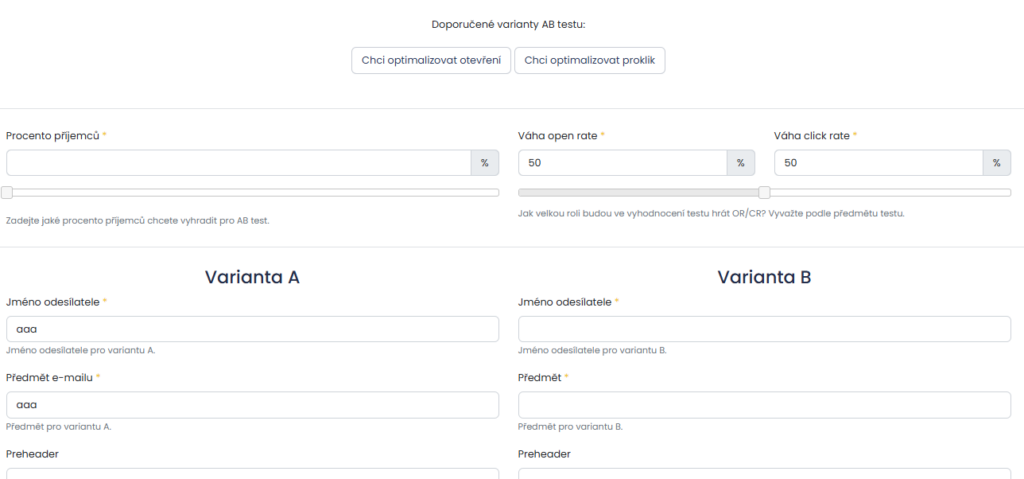
In the first step of the campaign creation wizard, tick the “Use AB testing for this mailing” option. You will then see a new option in the wizard for AB testing parameters. You can test different subjects, preheaders, and sender names, for example. The tool also allows you to create different versions of email template content, including different tags for Google Analytics.
Summary
Start A/B testing your email campaigns today. Formulate a hypothesis about how you could improve your campaign, set up a test, send out your emails, and track the results. You may see higher open or click-through rates, but even if you don’t, you’ll gain valuable insights about your audience that will help you improve future campaigns.
What to remember about A/B testing for email campaign optimisation:
✅ Formulate a hypothesis on how to improve your campaign
✅ Test all key elements of the email
✅ Prioritise A/B testing
Through continuous testing and optimisation, you can achieve better results and more effective communication with your audience. ?

