


What makes a great email subject line? Focus on these 7 principles to increase your open rate.
Michal Finta | 9. 1. 2026

We are obsessed with email subject lines. And you should be too. Without a compelling subject line that piques curiosity, your email content cannot fulfil its purpose. No opens means no clicks, and no clicks means no revenue.
Before you begin: Open rate after Apple iOS 15 update
Launched in June 2021, privacy features in iOS 15 allow Apple Mail users to block third-party tracking of email opens. Given that Apple owns 58% of the email client market share, this means that more than half of your brand’s open rate metrics do not reflect the actual number of people who actually opened your email.
“We know that a 60% open rate doesn’t mean that 60% of people actually opened your email,” says Farge. “But if we had a 60% open rate on Monday and we see 40% on Tuesday, we can compare campaigns and make decisions based on that. Maybe deliverability has decreased, so we’ll look into that.”
1. Personalisation helps you stand out in the inbox
In general, the larger the company, the more likely it is to use personalisation in email subject lines. Research by Email Machine shows that medium-sized companies personalise 3.35% of their email subject lines with the recipient’s first name, while small and medium-sized businesses do so in only 2.45% of cases.
In most cases, “personalisation” in an email subject line means using the reader’s first name – but our research suggests that the first name alone is not enough to increase open rates.
Brands that fully leverage the value of audience segmentation achieve better results through deeper personalisation. This is because combining segmentation and personalisation increases the relevance of email content—and that is the key factor in ensuring higher open rates, click-through rates, and conversions.
2. Shorter email subjects achieve better results
Most emails are opened on mobile devices, so it’s essential to think about mobile users when writing email subjects. You should always test your campaigns on both desktop and mobile to ensure they display exactly as you want them to – and that includes the email subject line.
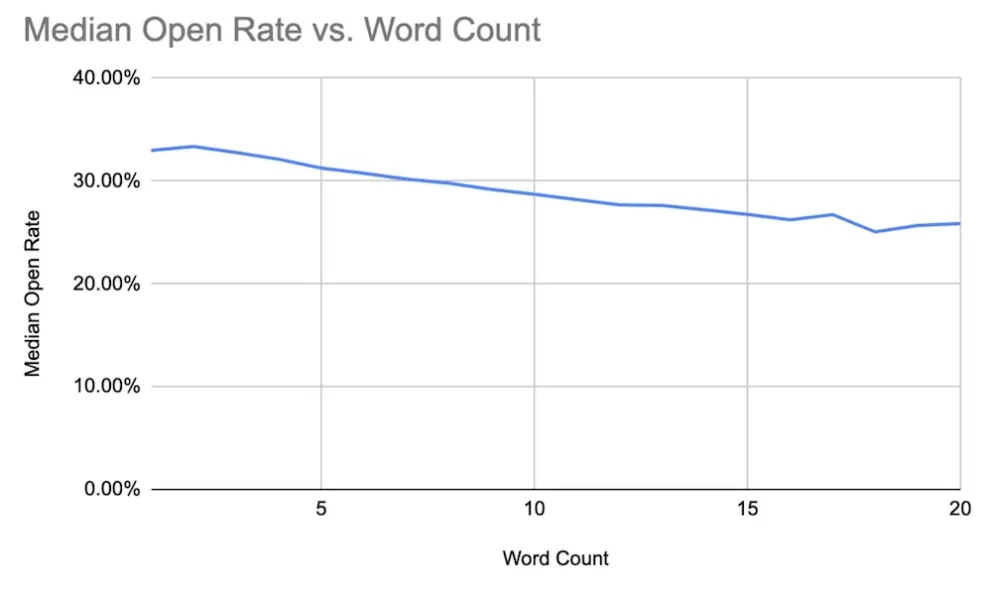
According to our research, the longer the subject line of an email, the less likely recipients are to open it.
How long should the ideal subject be?
The average length of messages across companies is 7 words (including emoticons). Data shows that this length results in an open rate of around 30%.
If you want to go even further and shorten your items even more – and thus possibly increase the open rate – you can rely on another important tool for arousing curiosity: preview text.
3. A well-thought-out preview text can offer a solution to the problem.
“Addressing the issue directly in the subject line of an email can significantly increase the open rate,” says Lukáš Haubelt, CEO of Brand Boost Media.
One of the most effective ways to achieve this is to introduce the problem in the subject line and hint at the solution in the preview text. This will pique curiosity and motivate the recipient to open the email.
4. Urgency and limited availability encourage openness—but with caution
Time-limited offers, exclusive promotions, emails alerting customers to “low stock” or sales create a sense of urgency and limited availability, two powerful triggers that motivate people to take action.
The simplest way to create a sense of urgency is to use phrases such as “time-limited” or “ending soon”.
Beware of excessive use!
Although these words no longer have as negative an impact on email deliverability as they once did, we still recommend careful and appropriate use depending on your audience to ensure your email does not end up in spam. Segments with low purchase intent may find an urgent tone, exclamation marks and CAPITAL LETTERS annoying. On the other hand, customers with a history of purchases or a high level of interest in your products may appreciate such communication.
5. Great email subjects create a “curiosity gap”
“The curiosity gap is the space between the information we have (what we know) and the information that is initially withheld (what we don’t know),” according to Brand Boost Marketing. This is something you want to create in your email subject line, because opening the email is how your audience closes that gap.
Curiosity is especially important if you are promoting a new product, collection, or campaign that has not yet been launched. However, keep in mind that what arouses curiosity will depend on the purchasing intent of your audience segment.
At the beginning of your relationship with subscribers, you may want to pique their curiosity about the key points of your story or the issues you are addressing.
After establishing a relationship and receiving signals of a higher purchase intent (e.g., website visits, abandoned shopping carts), you can direct curiosity towards specific product news.
Caution: Just as you would not want to read a novel without a resolution to the plot, email recipients will not appreciate curiosity that remains unresolved. If you arouse curiosity in the subject line of your email, ensure that the body of the email delivers on its promise and satisfies that curiosity.
7. Emojis are not bad in email subjects, but use them sparingly.
If you’re trying to stand out in a crowded inbox, you might think emoticons are a great way to grab attention.
But perhaps you’re getting lost in the crowd: according to Klaviyo research, 42% of medium-sized companies and 43.5% of small and medium-sized enterprises use emojis in their email subject lines.
Quick tips for using emoticons in subjects:
- Do not use more than one.
- Use emoticons to enhance your message, not to replace words.
- Remember that the aim of the subject line is to convey a clear message. If an emoticon helps you do that, use it.
Emoticons may appear differently depending on the email provider, so be sure to preview your email subjects on different providers and devices before sending.
Next steps: A/B test these elements for your email subject line
I have given you the knowledge, but to find out what works best for your brand, you will need to A/B test each element and find out what specifically works for you.
Based on these best practices, test the following elements one by one:
- Mention of product name vs. use of first name only
- Length of email subject line
- Preview text formulation
- Urgent language vs. more subtle language
- Email context scenarios
- One emoticon vs. none
- AI-generated objects vs. human-generated objects
This process will help you better understand what specifically works for your audience and increase the effectiveness of your email campaigns.
[button]

